



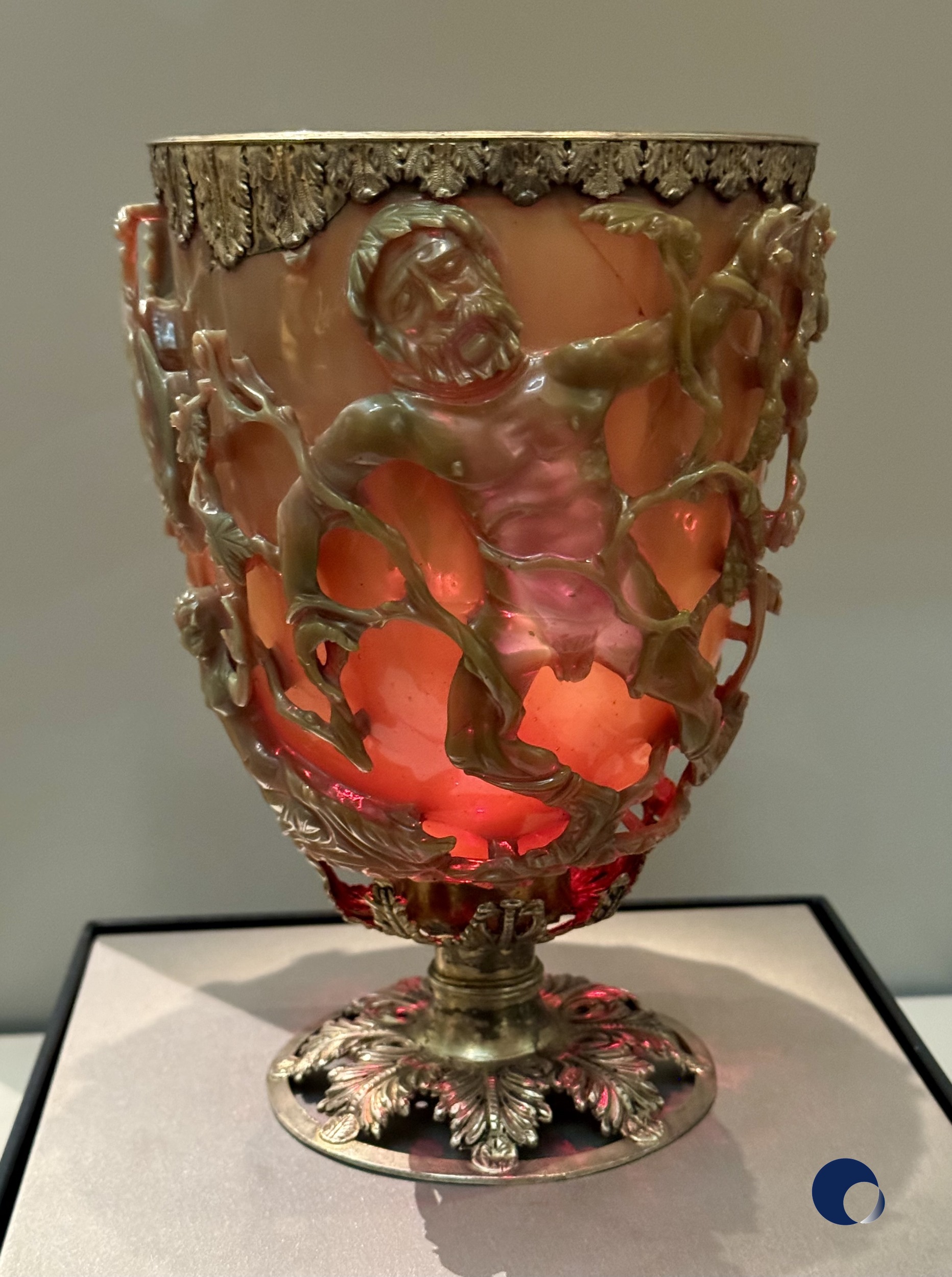
An Optical Illusion in the Museum's Gloom
Within the carefully dimmed galleries of the British Museum in London, an unassuming 16-centimeter-high goblet rests inside a glass case, guarding one of the most mesmerizing optical and material enigmas in human history: The Lycurgus Cup. Dating to the late 4th century CE during the twilight of the Roman Empire, this vessel appears as an opaque, earthy pea-green under standard ambient lighting. Yet the instant an illuminated light source is placed behind or within the goblet, the chalice undergoes an astonishing transformation, erupting into a vibrant, fiery, luminous ruby red.
For centuries, classical antiquarians and material historians were utterly baffled by this radical chromatic metamorphosis. The secret of the goblet remained locked until 1990, when scientists subjected tiny fragments to high-resolution transmission electron microscopy (TEM) and spectroscopy. The revelation astonished the scientific community: Roman craftsmen had intuitively harnessed the principles of "nanotechnology"—a discipline modern physics only began to master in the late 20th century—more than 1,600 years ago.
Plasmonic Resonance: The 70-Nanometer Miracle
Laboratory analyses demonstrated that Roman glassmakers had blended minute traces of gold and silver into molten silica glass in a ratio of just 40 parts per million. Crucially, these metals were not dissolved as coarse flakes, but as perfectly colloidal nanospheres averaging 70 nanometers in diameter—less than one-thousandth the width of a single human hair—dispersed uniformly throughout the glass matrix.
When light waves strike these gold-silver nanoparticles, the conduction electrons of the metals oscillate in collective resonance with the photons (surface plasmon resonance). Due to this quantum interaction, the glass scatters and reflects green and blue wavelengths (producing its opaque jade appearance under reflected light), but selectively absorbs green while transmitting red wavelengths straight through when lit from behind. This phenomenon establishes the Lycurgus Cup as humanity's earliest known synthetic dichroic nanomaterial.

“The Lycurgus Cup embodies the supreme ambition of architectural material philosophy: matter is never merely a passive vehicle for form, but an active, living transformer of light, time, and perception.”
The Diatretum Craft: Carving the Impossible Relief
The Lycurgus Cup stands as a pinnacle of ancient craftsmanship not only for its nanoscale chemistry, but equally for its unparalleled sculptural virtuosity. The vessel was fashioned using the exceptionally arduous "diatretum" (cage cup) technique. Contrary to initial assumptions, the intricate decorative figures were not molded or soldered onto the exterior; they were painstakingly undercut and hollowed out from a single, thick blank of blown glass through months of grinding with rotary wheels and abrasive pastes.
The dramatic relief illustrates the mythological downfall of King Lycurgus of Thrace. Having insulted Dionysus, god of wine and divine ecstasy, the king violently attacked the sacred maenad Ambrosia. In desperation, Ambrosia prayed to Mother Earth, who transformed her into a rapidly burgeoning grapevine. With astonishing delicacy, the Roman sculptor carved the twisting vine branches so that they remain largely detached from the goblet's main body, suspended in mid-air by gossamer-thin glass bridges as they ensnare the king. As Lycurgus struggles helplessly within the vine's choking tendrils, his agony transforms into a theatrical visual narrative, turning literally blood-red whenever the cup is back-lit.

From Imperial Feasts to Quantum Photonics
Historians hypothesize that this extraordinary chalice was reserved for imperial state banquets or clandestine Dionysian mysteries. The refractive index of the glass shifted subtly depending on the density and alcohol content of the liquid poured within, producing mesmerizing color shifts across the vessel. In effect, the cup served as the ancient world's first bio-optical liquid sensor and ambient indicator.
Acquired by the Rothschild family in the 19th century and welcomed into the British Museum collection in 1958, the Lycurgus Cup delivers an indispensable lesson for contemporary architecture and material design. The modern architectural pursuit of "responsive envelopes"—dichroic smart facades, photoluminescent glazing, and kinetic daylight filtration—was already achieved 1,600 years ago through empirical curiosity and uncompromising craft.
The Nexus of Past and Future
The Lycurgus Cup reminds us that advanced material intelligence is not the exclusive domain of the digital epoch. When deep intuition of physical matter fuses with alchemical mastery and unyielding craftsmanship, it yields enduring monuments that transcend both nature and time.
Content: Moon Content Team
