



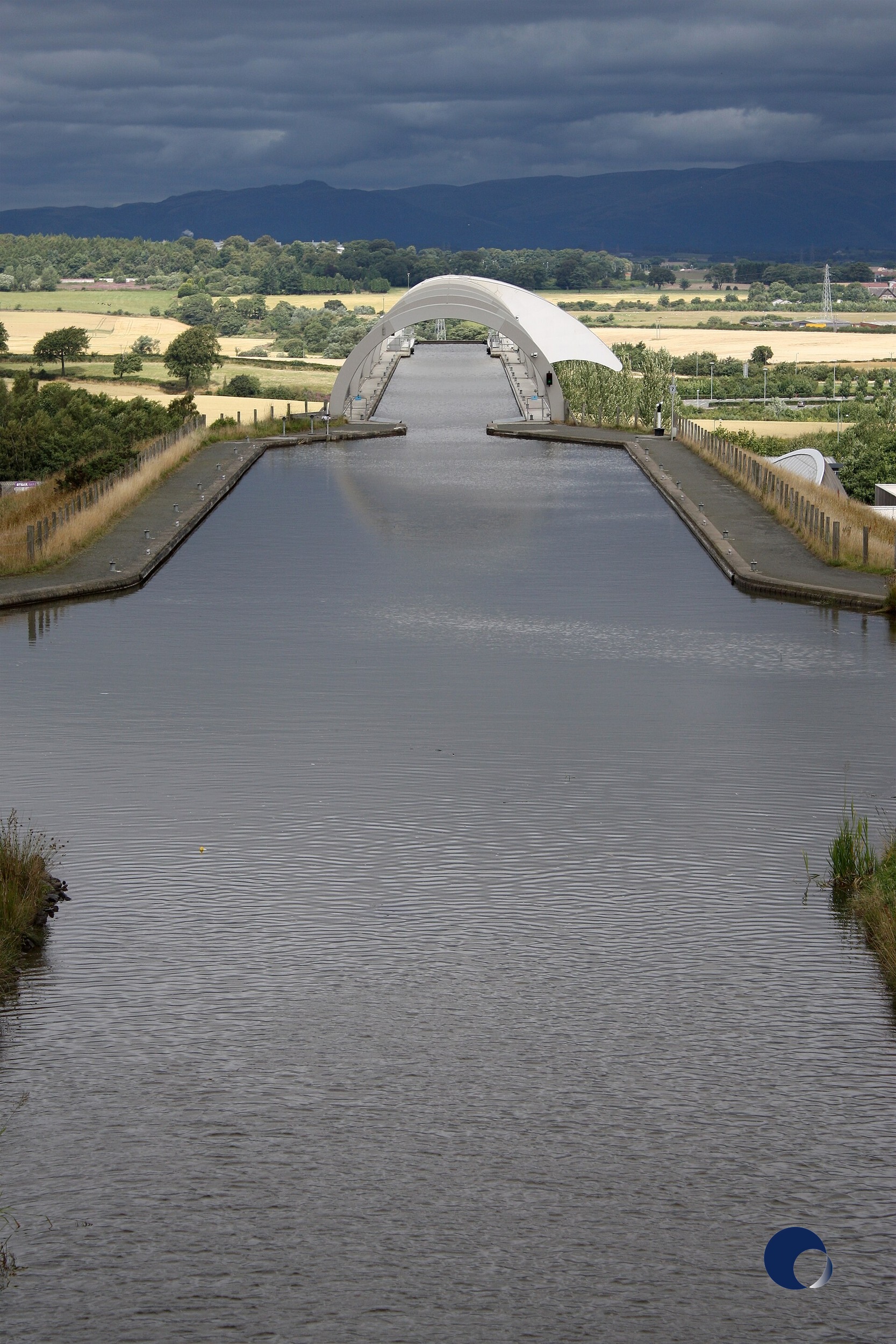
A Steel Waltz with Water: A Monument in the Scottish Lowlands
Soaring 35 meters above the tranquil rolling hills of central Scotland, adjacent to the ancient frontier of Rome's Antonine Wall, stands a breathtaking triumph of structural engineering and sculptural grace: The Falkirk Wheel. Evoking the aerodynamic sweep of a Celtic double-headed axe (labrys) or the monumental spine of a breaching whale, this kinetic sculpture holds the distinction of being the world's only rotating boat lift.
Inaugurated in 2002 by Queen Elizabeth II as part of the Millennium Link project, this infrastructure was conceived to reconnect two historic inland waterways—the Forth and Clyde Canal with the Union Canal—severed since the 1930s by an imposing 35-meter (115-foot) elevation drop. Historically, traversing this cliff required negotiating an exhausting flight of 11 sequential lock chambers over nearly half a day; The Falkirk Wheel floats passenger barges through the open sky, completing the entire vertical ascent in a mere 5.5 minutes.
Archimedes’ Principle and Kinetic Equilibrium: The Power of 8 Kettles
The authentic stroke of genius distinguishing the Falkirk Wheel from conventional industrial infrastructure lies in its masterful harmony with the fundamental laws of classical physics. Mounted on the twin tips of its rotating arms are two massive water-filled caissons (gondolas), each holding roughly 300 tons of water. These gondolas operate in strict accordance with Archimedes’ principle of flotation: whenever a boat enters a caisson, it displaces a volume of water equal to its exact weight.
Consequently, whether a gondola accommodates a fully loaded 20-meter canal barge or holds only water, both arms of the wheel remain in flawless, perpetual mass equilibrium at approximately 600 tonnes each. Because the system is balanced to within millimeters, rotating the colossal 1,200-tonne assembly through a 180-degree revolution requires a meager 1.5 kilowatt-hours (kWh) of electrical energy—equivalent to boiling approximately eight domestic household kettles.

“The Falkirk Wheel demonstrates that when technology dances in sublime harmony with universal physics rather than fighting nature, thousands of tons of steel can glide through the air as weightlessly as a feather.”
Mechanical Poetics: The Elegance of Planetary Gears
During rotation, the supreme engineering imperative was ensuring that the water-filled gondolas remained perfectly horizontal at every fraction of a degree. Any tilting would cause hundreds of tons of water and passengers to spill catastrophically into the void below.
Rather than relying on vulnerable computer-driven hydraulics or complex sensors, architect Tony Kettle and the engineering team deployed a pure mechanical marvel: an inverted planetary gear system dating back to centuries-old horology. Three synchronized intermeshing gears link the central stationary axle directly to the gondola bearings. As the main arms sweep through the sky, the planetary gears counter-rotate the caissons at the exact angular velocity, guaranteeing that the boats remain steadfastly level by immutable geometric law.

From Industrial Infrastructure to Global Icon
Throughout history, canal locks and maritime lifts were treated as purely utilitarian contraptions—cumbersome, rusted machines that scarred the landscape. The Falkirk Wheel boldly redefined infrastructure as monumental civic sculpture. The approach aqueduct, engineered in sculpted board-marked reinforced concrete, reinterprets Roman arches with fluid, dynamic modern curves that integrate seamlessly into the Scottish topography.
For contemporary architects and master builders, the wheel issues a profound provocation: structural design is never condemned to remain static or inert. Kinetic architecture extends far beyond automated facade louvers; it is the art of setting heavy structural masses into fluid, harmonious motion alongside gravity, water, and the human spirit.
Transcending Water and Time
The Falkirk Wheel stands as enduring testimony to what human imagination can achieve when it approaches natural law with humility and artistic courage. Here, mechanics transforms into poetry, water ascends to heaven, and the past links hands with tomorrow.
Content: Moon Content Team
