


Architecture is not always about building from scratch; more often, it is the art of reinterpreting the potential of what already exists and envisioning a new future upon it. Rising in Paris’s 17th arrondissement, 42UP, designed by AR Studio d’Architectures, stands as one of the most radical and compelling examples of this “reconfiguration” approach. Conceived as the expansion project of the world-renowned coding school École 42, the building vertically integrates a 24/7, experience-driven educational model—free of teachers, mandatory classes, and tuition fees—into the existing urban fabric.
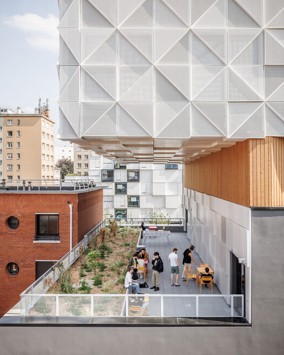
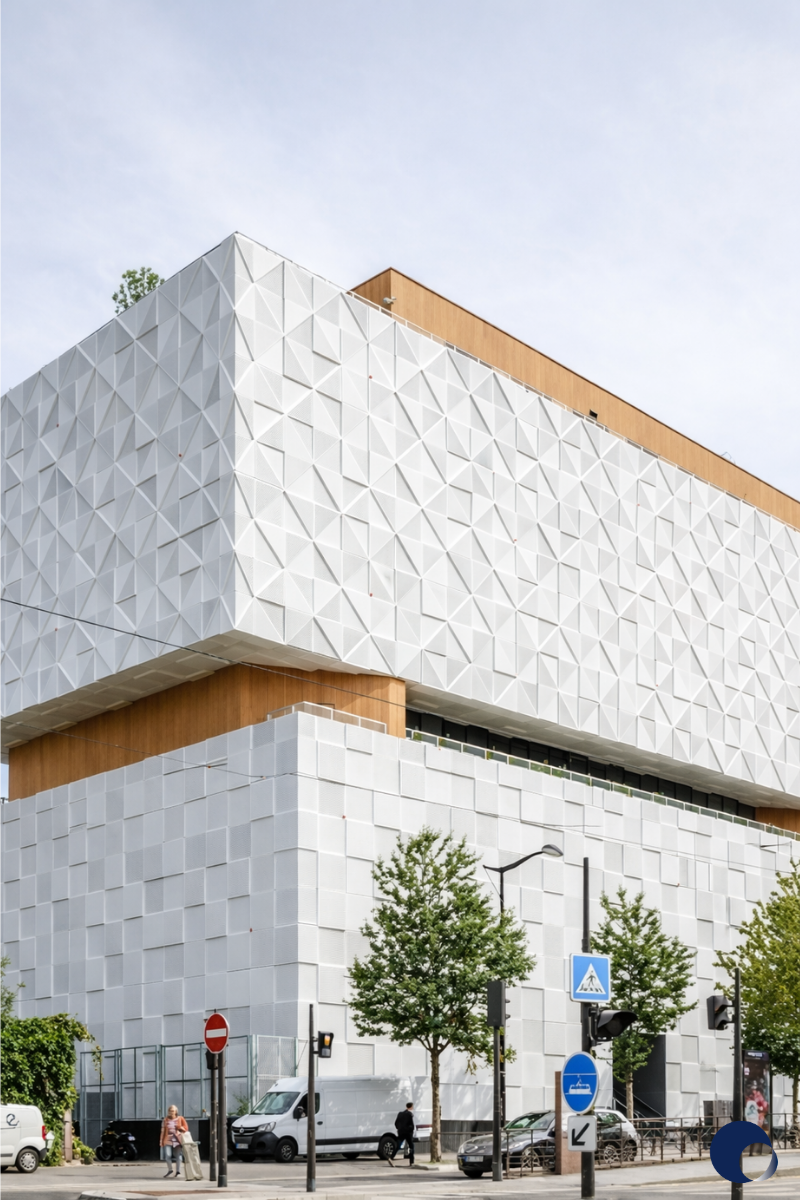
The project site originally housed a building constructed in 1962 on Paris’s former fortifications, known as Bastion 42. Rather than demolishing this structure, the architects adopted a strategy that preserves, reinforces, and redefines its meaning. The existing building was transformed from a passive base into the structural and conceptual backbone of the new architectural narrative. In line with this approach, a massive metal superstructure—composed of four primary volumes and rising five storeys to a height of approximately 18 metres—was added above the original building. As a result, the total usable area was expanded from 3,600 m² to 9,025 m².
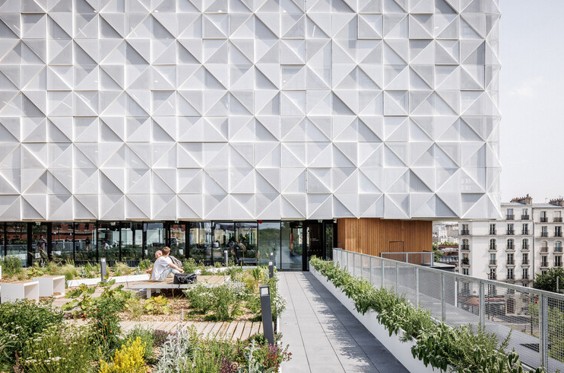
This design decision represents a powerful interpretation of frugality in architecture: generating maximum spatial value with minimal intervention, without exhausting existing resources. From an engineering standpoint, the project’s most striking feature is the suspended “bridge-building” form, supported by vertical circulation towers and a single 42-metre-long mega-beam. Thanks to this bold structural move, the third floor is entirely free of columns and transforms into a generous public terrace—an urban balcony overlooking the Parisian skyline. Here, the educational environment extends beyond enclosed interiors, evolving into an experiential space that establishes a direct visual and spatial dialogue with the city.
Façade Design
The building envelope is wrapped in a white micro-perforated metal skin that emphasizes continuity between old and new. At the lower levels, the façade begins with a 1.17 × 1.17 metre modular grid, which gradually evolves into triangular modules across the upper metal superstructure, giving the façade a dynamic, sculptural relief. This transformation visually lightens the building’s mass and turns the façade into a responsive surface that changes with daylight conditions throughout the day.
Beyond its aesthetic qualities, the façade functions as a performative architectural layer, responding to the building’s intensive technological use:
- Solar Control: It provides effective shading to balance the significant heat load generated by approximately 1,400 computers inside the building.
- Light and Transparency: The micro-perforated metal filters daylight into the interior, establishing a constantly shifting visual relationship between inside and outside throughout the day.
In conclusion, 42UP powerfully demonstrates that existing buildings can be transformed rather than demolished, and that vertical growth within dense urban contexts can be both an aesthetic and sustainable architectural strategy. By combining engineering boldness, spatial flexibility, and environmental sensitivity, the project offers an inspiring model for how contemporary educational buildings can meaningfully integrate with the city.