



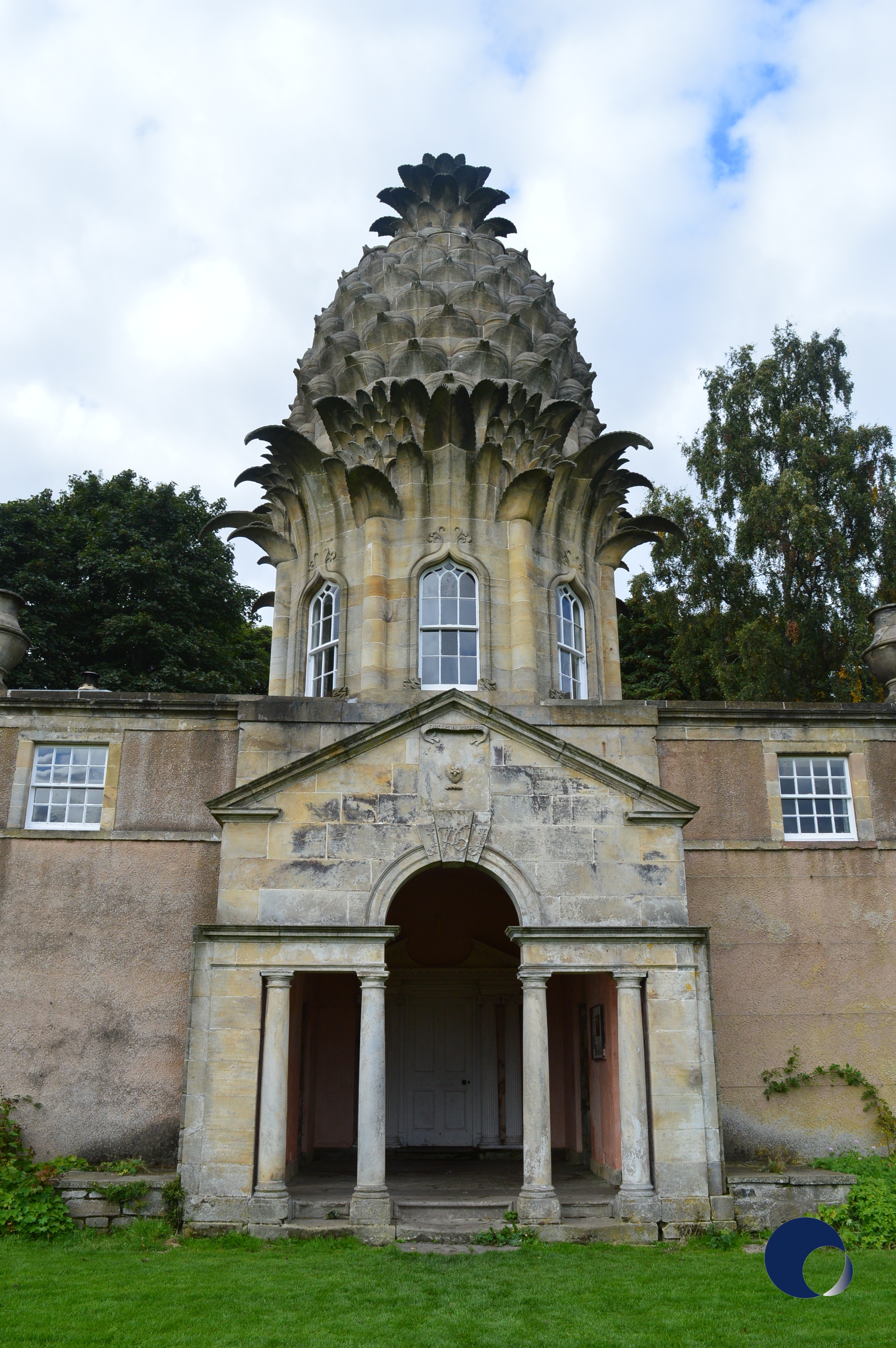
A Botanical Hallucination Amid the Northern Mists
In the rolling rural landscapes of Falkirk, Scotland, as the cool mists of the ancient Dunmore woods gently part, an unexpected silhouette defies every classical rule of rational order and axial symmetry: a monumental, intricately carved stone pineapple soaring 14 meters into the open sky. Appearing at first glance like an eccentric fairytale illustration or a lighthearted architectural folly, this monument—celebrated in architectural history as "The Dunmore Pineapple"—stands as one of the most audacious, structurally sophisticated follies ever erected. Yet beneath its spiky, ribbed stone carapace lies far more than aristocratic whimsy: it conceals the pinnacle of 18th-century European stone stereotomy and thermodynamic ingenuity.
From Royal Banquets to Stone Monument: The Iconography of the Pineapple
In the 18th century, the pineapple was neither a common botanical specimen nor merely an exotic dessert; it was the ultimate emblem of sovereign wealth, transatlantic conquest, and peerless luxury across European courts. In northern climates like Scotland, owning a ripe pineapple was equivalent to possessing a rare masterpiece or a modern luxury yacht. Indeed, aristocratic families frequently rented pineapples for the night simply to parade them as centerpiece showstoppers at lavish galas before returning them untouched.
When John Murray, 4th Earl of Dunmore, returned to Scotland following his tenure as the Crown Governor of the Colony of Virginia in the late 1770s, he resolved to elevate the maritime tradition of placing pineapples upon gateposts to announce a sailor’s safe homecoming into an unprecedented architectural statement: he would erect a colossal stone pineapple crowning the very heart of Dunmore Park’s walled fruit garden.

“The Dunmore Pineapple stands as living testament to how nature’s most intricate biological forms can achieve flawless reconciliation with the rigid rationality of stone; here, architecture never bowed to material constraints, but stretched the medium to the very frontier of imagination.”
The Limits of Masonry: Stereotomy and the Genius of Rain Drainage
What elevates The Dunmore Pineapple from a mere ornamental garden folly into an authentic architectural tour de force is the seamless synthesis of an asymmetrical, organic fruit morphology with the exacting discipline of ashlar masonry. Stone is intrinsically rigid, heavy, and linear; yet the anonymous Scottish masons shaped local freestone sandstone as though it were pliable wax, sculpting dozens of individual, overlapping leaves that radiate outward with kinetic life.
While the lower tier of prickly stone fronds cantilevers dramatically outward from the octagonal drum—effortlessly counterbalancing the structure’s center of gravity—each carved scale tapering toward the crown features a micro-calculated convex slope. In Scotland’s harsh winters, any rainwater trapped within the crevices would freeze, expand, and shatter the stone. Anticipating this structural vulnerability, the masons graded the upper surface of every single leaf with precise drainage angles, ensuring that precipitation cascades naturally downward from leaf to leaf like a miniature aqueduct. Flanking the octagonal base, pointed Gothic lancet windows illuminate the pavilion’s interior while casting a dynamic, shifting play of light and shadow across the sculpted stone facade throughout the day.

Double-Walled Cavity Hypocaust: A Tropical Microclimate in Freezing Climes
The Pineapple was not merely a sculpture reaching toward the Scottish heavens; it functioned as the architectural heart of an exceptionally sophisticated bioclimatic greenhouse. Flanking the central pavilion, the vast curved brick walls of the garden were engineered with a double-walled (cavity) flue system inspired by ancient Roman hypocausts.
Furnaces built behind the walls circulated hot air and smoke through the hollow interior masonry, charging the brick’s thermal mass and keeping the walls continuously warm for 24 hours a day. Slanted glass lean-tos erected along the southern face of these heated walls trapped solar gain, cultivating a stable tropical microclimate capable of nurturing genuine pineapples, melons, and citrus trees while Scottish blizzards raged just beyond the boundary. The structure’s most poetic camouflage crowned the parapet above: rather than exposing utilitarian chimney pipes, the heating flues were disguised as elegant classical stone urns and vases, blending mechanical utility seamlessly into classical beauty.
The Timeless Irony and Architectural Legacy
Originating in 1761 as a modest Palladian summer pavilion and crowned after Lord Dunmore’s return with this breathtaking fruit cupola, The Pineapple is preserved today under the stewardship of The Landmark Trust and National Trust for Scotland. Though architectural historians often attribute the initial design concepts to Sir William Chambers, the true genius of the monument belongs to the anonymous master masons whose chisels brought stone to life.
The Dunmore Pineapple continues to whisper an enduring lesson to contemporary architects and designers: architecture must never be confined to sterile boxes and cold utility. When technical audacity, irony, daring imagination, and flawless craftsmanship converge, even a stone fruit can transcend nature and stand as a timeless monument to human wonder.
Content: Moon Content Team
