



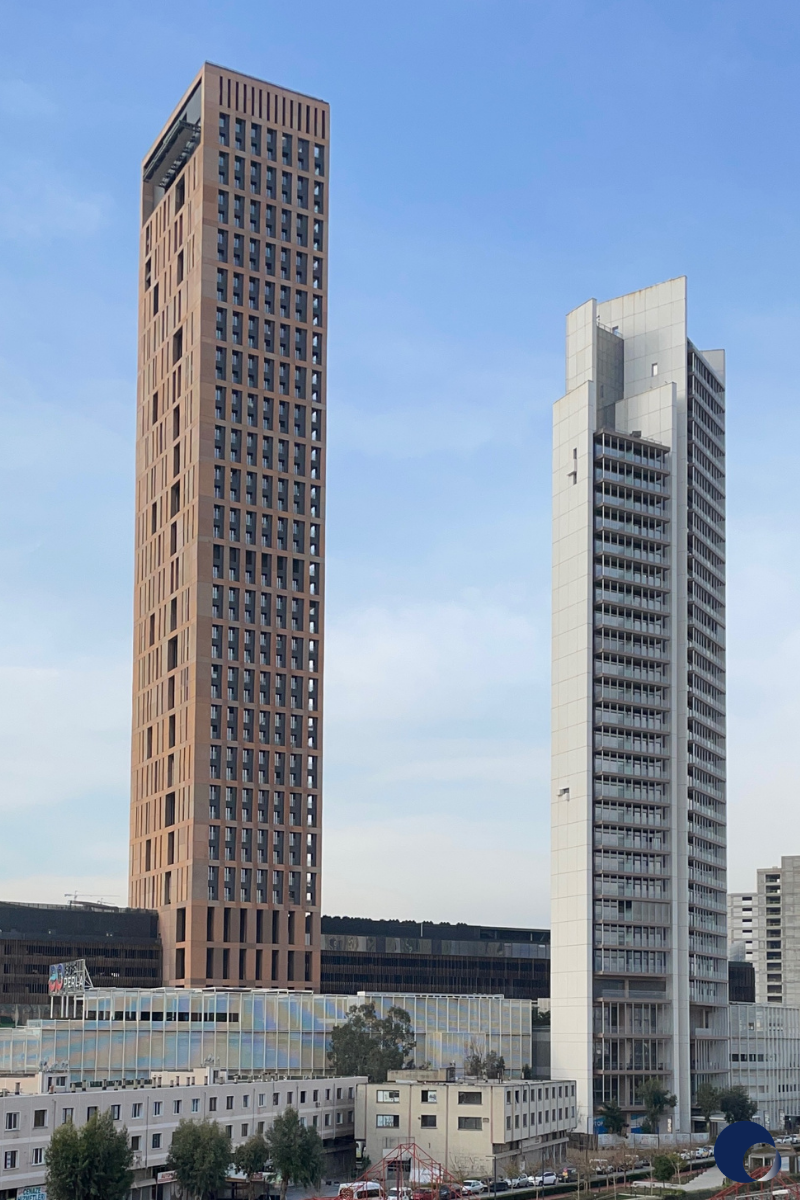
It can be easily argued that İzmir is a unique city, both as Turkey’s westernmost urban center and in terms of the freedoms created by its democratic inclinations. In the project prepared for the multi-functional building complex (mixed-use) developed by İş Gayrimenkul Yatırım Ortaklığı in the Bayraklı district, in addition to the sociological and cultural climate mentioned above, several key criteria emerged: the site’s specific location within the city, its position at the intersection of several main arteries, the zoning regulations established for the area, and the social effects that the complex is expected to bring to the neighborhood. Within this framework, it was aimed to positively address risks of urban fragmentation and social segregation, as well as the potential tension arising at the intersections of public and private spaces.
Furthermore, the complex program was evaluated with respect to urban life and private usage, emphasizing cross-programming of functions, climatic considerations, landscape relations, silhouette effects as perceived both from the sea and the city, sustainable building solutions, and ecological design approaches. The site is located in one of İzmir’s newly developing areas. Its strategic position—both in terms of transportation and its relationship with the city center—played a significant role in shaping the massing decisions of the complex.
Primary usage and service connections were determined by evaluating data from a previously prepared technical transportation report regarding access to and distribution from the site. The anticipated density of the project was assessed so as not to disrupt surrounding roads or impede traffic flow. In the second half of the 20th century, decentralization in major European countries and the U.S. led to the emergence of shopping and lifestyle centers first on the outskirts and later in revalorized city centers, forming distinct architectural and functional typologies. Despite this diversity, these centers generally became self-contained sub-centers.
In line with the idea of concentrating retail activities for maximum profitability, it was envisioned that these centers would be supported with food and beverage, entertainment, and cultural facilities. Ice-skating rinks, Ferris wheels, tropical forests, pirate ships, or submarine pools—fantastical elements detached from their original contexts—became symbols of these centers. Architects sought to explore this fantasy by creating unexpected functional combinations within the complexes. Such projects, however, often led to social class segregation and contributed to urban fragmentation and societal separation.
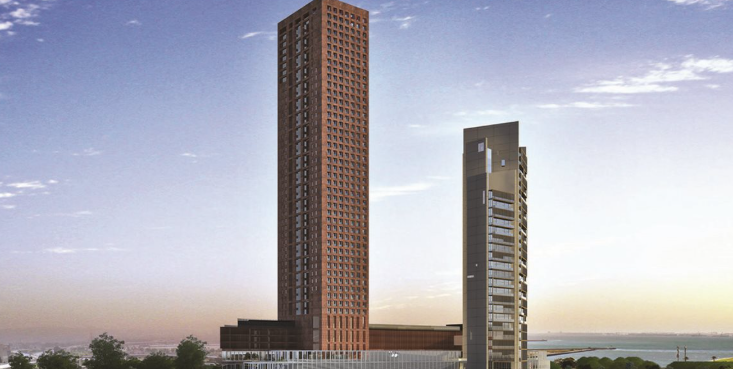
One of the key objectives of this project was to address these social divisions and challenges in its design approach. To this end, the dual-branch shopping area was designed as a linear, open system, easily accessible both from Ankara Road and the seaside, contrary to the closed layouts of conventional centers. The high-rise residential and office blocks were positioned independently from the shopping and lifestyle complex, standing on their own plinths—an important design decision. Moreover, maintaining a controlled floor area for these buildings allowed for wider platforms for public use while ensuring that public and private zones could coexist without interfering with each other.
The extensive terraces, along with differentiated wind and sunbreakers, contribute to the internal life of the buildings and the project’s uniqueness through a crystallized permeability. The height difference between the two tall structures was also intended to generate a positive perception at the urban scale.
Content: Tasarım Group
