



Located in Dalaman, within the borders of Muğla province on Turkey's Mediterranean coast, Dalaman International Airport consists of two terminals built in 2006 and 2019, respectively. With a total indoor area of 222,000 square meters, it meets a significant transportation need in the region. The design, aiming to combat the sense of monotony and lack created by the standardization of terminal structures, sought to problematize the convention of international airports through the region's rich landscape, climatic features, and the specificity of local tourism activities. Departing from the typical mass arrangements dictated by the disproportionate dimensions of long and thin pier areas relative to relatively shorter and thicker halls, the plan developed artificial valleys through the voids between the interior spaces and fragmented external masses. These voids ensured the continuation of the existing landscape, both naturally outside and in an abstract form inside. The fact that the terminals would be predominantly used during the summer season, the circulation of arriving and departing passengers on separate floors, the visual fluidity between interior spaces and different levels, and the attractiveness of commercial units were other important inputs.
Making passenger flow as comprehensible as possible and organizing it comfortably even during peak periods was another critical criterion of the design. The system, avoiding grand and acrobatic structural
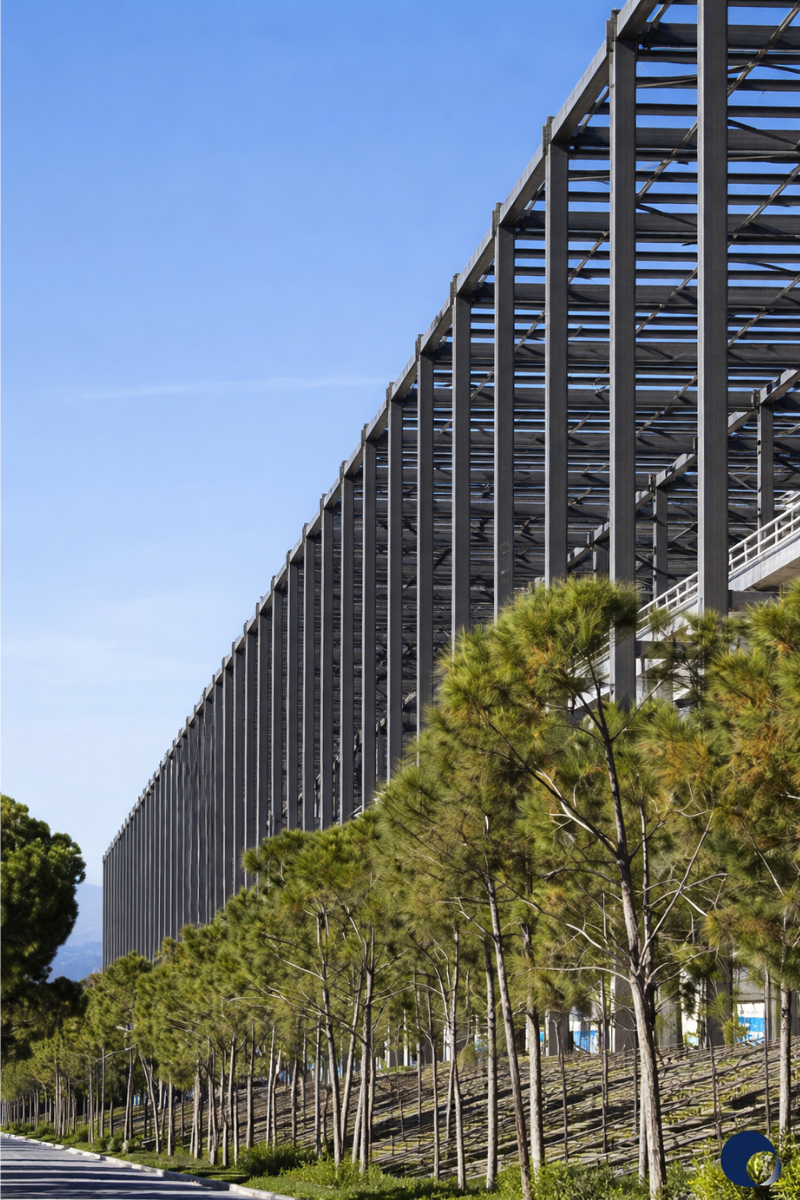
claims, was created with a simple reinforced concrete grid structure and a steel roof constructed from standard profiles, elevated 2.50 meters from the concrete structure, separated by one axis horizontally. This cover, with the gap between the two roofs and sun-shading elements, aimed to create its own microclimate and establish a holistic tranquility through its regular repetition over fragmented masses by allowing airflow. The photovoltaic panels on the sun-shading system were designed to help produce a portion of the terminal's required energy, thus minimizing energy consumption.
Another design decision involved using materials such as bare concrete, natural wood, and matte flooring instead of shiny and glittering surfaces, continuing the questioning initiated by the building's massing within the interior spaces. The structural network created by the electro-mechanical system used in both terminals was made visible in appropriate sections of the interior spaces instead of being covered by conventional suspended ceilings. Within this framework, these systems were also designed as an integral part of the architectural project.
"The design, aiming to combat the sense of monotony and lack created by the standardization of terminal structures, sought to problematize the convention of international airports through the region's rich landscape, climatic features, and the specificity of local tourism activities."
Content: Tasarım Group
