



Today in Bergama, two very different images coexist. One is the ancient city of Pergamon, which includes the Pergamon Altar—much of which is currently exhibited in the Berlin Museum. The acropolis, which served as the capital of the Pergamon Kingdom that ruled the region between the 3rd and 1st centuries BCE, presents the physical manifestation of an urban culture built upon a deeply rooted civilization.
Within this settlement—where administrative, religious, cultural, and commercial functions came together—structures that never compromise their own geometric existence stand side by side through successive additions. The spaces left between these buildings create rich public areas. The monumental scale of the ancient theater, which remains impressive even by contemporary standards, offers insight into the social and cultural life of the city. With its strong architectural grammar and monumental presence, the ancient city continues to inspire admiration even today.
Looking down from the Acropolis, the Bergama that appears below resembles an expanded rural fabric. The typical low-rise buildings found in many other towns across Turkey have gradually begun to give way to apartment blocks. Within Bergama, the only element that defines a sense of urban image is Cumhuriyet Street, on which several public buildings are located. Commercial activity in the city concentrates along this street and along the parallel Kaymakam Kemal Bey Street. At the end of the street there is a small grove and a stadium. Apart from these, everything else seems to reflect a rural mode of existence. In the district, aside from two cinema halls—one of them quite old—a small theater, and a library, there are few signs of cultural life.
Can a relationship be established between the Acropolis and Bergama? This question, which risks becoming naïve through repetition, does not seek to produce a short circuit between two different cultures. Instead, it searches for a definition of a place that can host the cultural life of today’s Bergama without hesitating to be influenced by the memory embedded in the site.
The area designated for the cultural center is located between the city’s two main streets, directly across from a park frequently used by the residents of Bergama. The commercial activity that continues along Cumhuriyet Street is sustained here by makeshift shops that have extended informally onto the sidewalks. These shops, which run along three edges of the site, appear to have become part of the city’s collective memory with their human scale and unpretentious presence. Preserving the vitality of this commercial life without displacing the shopkeepers emerges as one of the key reference points of the design.
The idea that culture becomes attractive and sustainable once it intersects with mechanisms of consumption is considered important—while acknowledging that an excess of sophistication may diminish attractiveness, and an excess of consumption may result in a loss of depth.
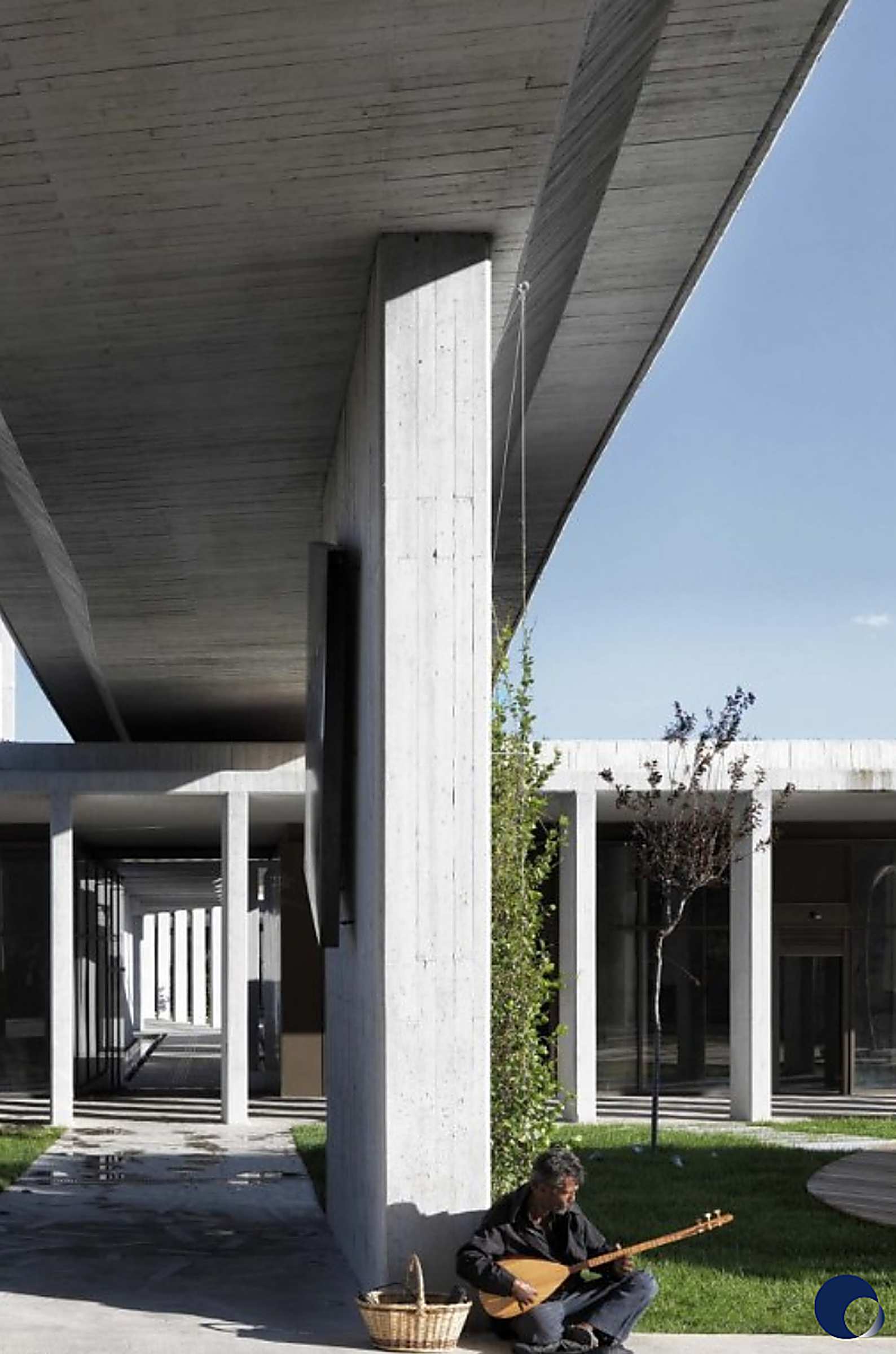
The commercial units along Cumhuriyet Street are pulled back slightly from the street line in order to maintain the façade alignment along the avenue, creating a shaded arcade in front. This arcade surrounds the site on three sides and forms an interior space resembling a courtyard. The double-sided shops activate the life within this courtyard. Three large volumes placed within the courtyard house the library, cinemas, and theater, forming the spaces where cultural activities intensify. Rising above the arcade and becoming visible from the street, these volumes represent their functions through strong geometries, while the spaces left between them create rich public areas open to communal use.


Content: Tasarım Group
