



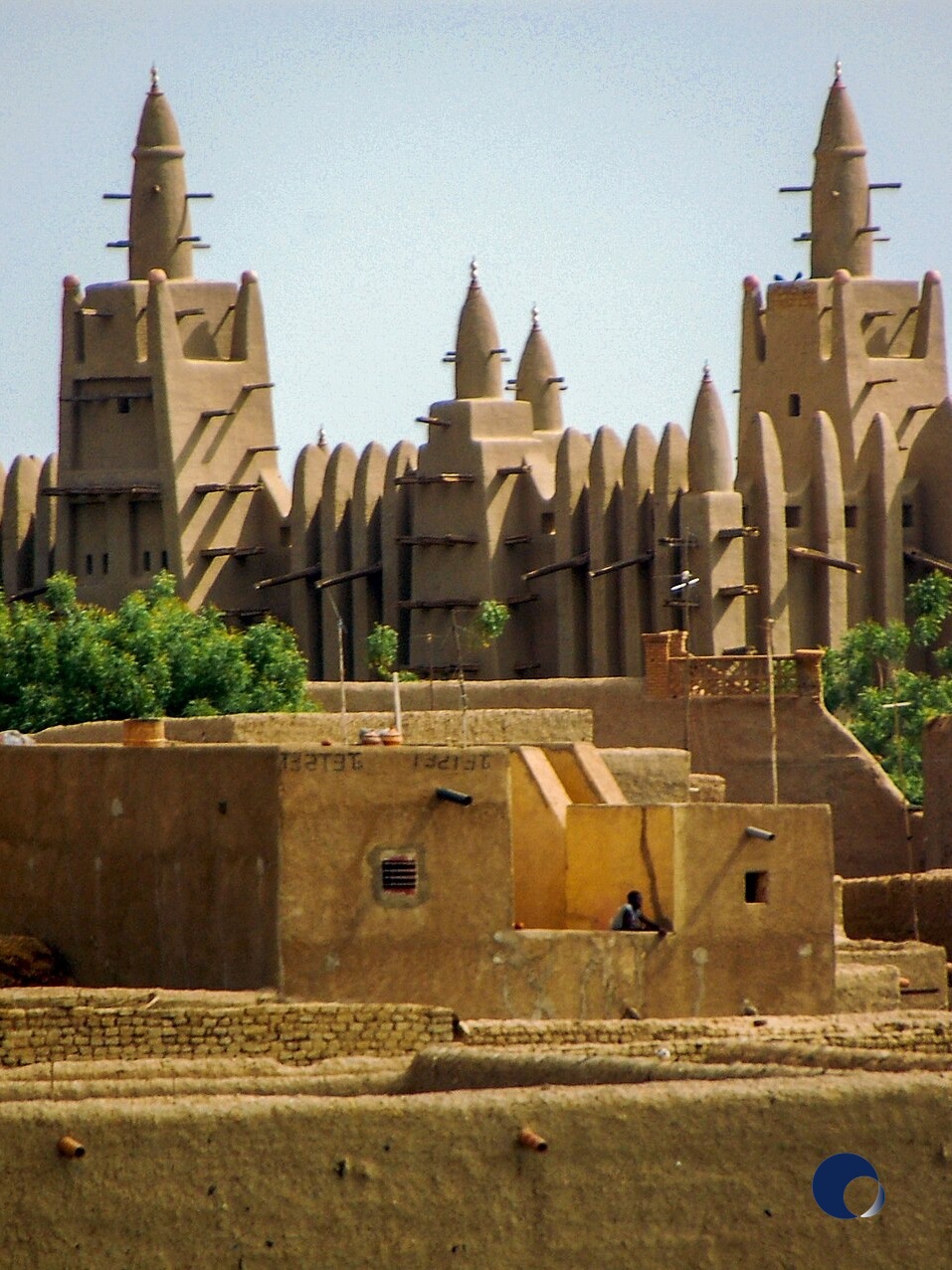
Monumental Memory Risen from Soil
Rising serenely above the Bani River floodplains at the southern rim of the Sahara Desert, the Great Mosque of Djenné represents humanity's most majestic architectural dialogue with the earth. Founded in the 13th century and reconstructed in its present monumental glory in 1907, the mosque stands as the undisputed pinnacle of Sudano-Sahelian architecture.
Where Western traditions relied upon quarry-hewn granite, carved marble, and structural steel to endure the centuries, Djenné was forged entirely from sun-dried mud bricks called 'ferey'—a matrix of river silt, straw, and fermented rice husks. Yet its enduring immortality lies not in defying natural degradation, but in embracing erosion as a cyclical invitation for communal renewal.

“The Great Mosque of Djenné proves that architecture is never a frozen monument; it is living biology reborn every season through human devotion.”
The Toron System: Permanent Scaffolding Woven into the Facade
Gazing across the monumental earthen facades, the eye is instantly drawn to hundreds of rhythmically projecting bundles of rodier palm wood. Known locally as 'toron,' these monumental timber timbers serve a dual engineering imperative: they absorb differential seismic and wind shear, while simultaneously creating permanent, built-in scaffolding.
When intense annual monsoon downpours wash away outer plaster layers, the entire city unites for the legendary 'Crépissage de la Grande Mosquée.' Young men scale the toron timbers with acrobatic agility, ferrying fresh mud mortar in wicker baskets, while master masons smooth the clay by hand, reviving the structure’s monolithic skin within a single daylight cycle.

Thermal Mass and Desert Aerodynamics
Reaching thicknesses of up to 60 centimeters, the earthen ramparts of Djenné constitute an extraordinary archetype of passive climatization. Under scorching Saharan temperatures exceeding 45°C, the profound thermal inertia of the walls absorbs solar heat, delaying interior thermal transfer by up to twelve hours.
As ambient temperatures plunge after dusk, the stored warmth radiates inwards, tempering the hypostyle hall throughout chilly desert nights. Concurrently, ceramic-capped roof apertures induce convection currents that purge overheated air, generating a naturally cooled microclimate supported by ninety interior mud pillars.
Lessons for Tomorrow's Circular Architecture
As contemporary architecture grapples with carbon footprints and embodied energy, the Great Mosque of Djenné provides a timeless masterclass in zero-waste circular tectonics. Composed entirely of biodegradable vernacular materials that return harmlessly to the earth upon decommission, Djenné demonstrates that genuine sustainability is born not of complex computation, but of deep reverence for local soil and collective spirit.
Content: Moon Content Team
