



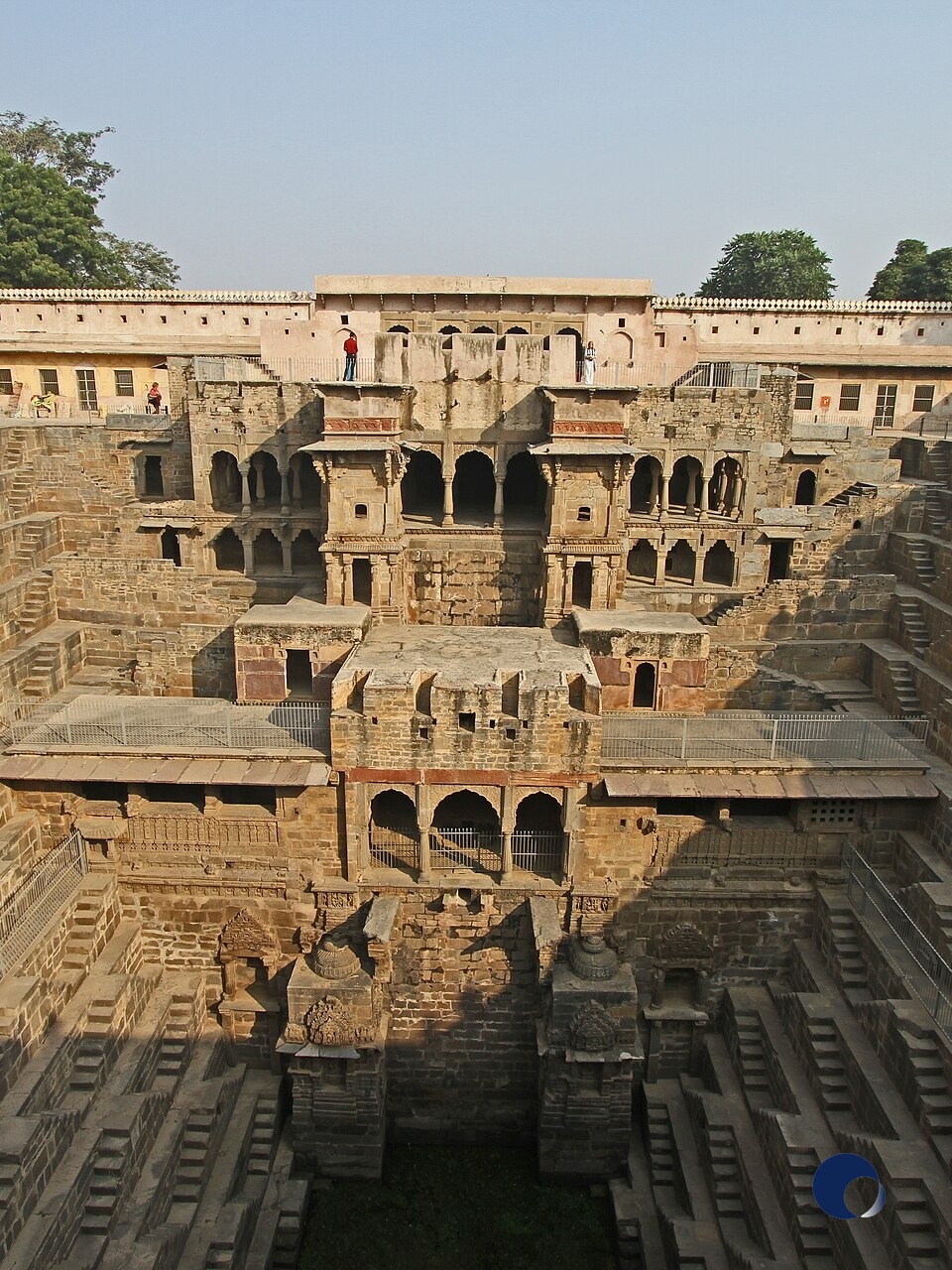
The Inverted Twin of the Heavens
Across the arid plains of Rajasthan in the village of Abhaneri lies an architectural abyss carved with astonishing precision. Engineered in the 9th century under King Chanda of the Nikumbha dynasty, Chand Baori completely upends classical architectural intuition: rather than celebrating monumental mass ascending toward the sky, the monument chisels an inverted pyramid deep into the earth.
Plunging 30 meters downward—the structural equivalent of a thirteen-story building—this subterranean monument is lined with 3,500 impeccably dressed volcanic and sandstone steps. It was conceived not merely as a utilitarian cistern to trap monsoon runoffs, but as a breathtaking spatial sanctuary where negative space evokes profound transcendence.

“Chand Baori stands as proof that architecture hewn into the deep womb of the earth can transmute negative space and geometry into profound reverence.”
Mathematical Rigor Across 3,500 Steps
The three primary subterranean flanks of Chand Baori are terraced with recurring triangular and inverted-V step motifs. Anticipating M. C. Escher's labyrinthine impossible geometries by a millennium, the steps induce a dizzying optical illusion where ascents and descents seamlessly merge.
Far beyond aesthetic drama, this rhythm served an essential hydraulic function. As the water table oscillated dramatically between torrential monsoon surges and blistering summer droughts, the fractal steps ensured that inhabitants could safely access the water line at any elevation without structural congestion.

Subterranean Microclimate and Passive Cooling
While ambient surface temperatures in Rajasthan routinely exceed 45°C, the deepest floor of Chand Baori remains 5°C to 6°C cooler. Shielded from direct solar exposure by steep embankment angles, the subterranean shaft harnesses evaporative cooling to sustain an astonishing natural microclimate.
On the northern facade, a multi-tiered palace pavilion featuring ornate jali screens, corbeled arches, and royal balconies provided a cool subterranean retreat where rulers and citizens gathered during searing midday heat to rest, meditate, and celebrate social rituals.
The Psychology of Subtractive Architecture
Chand Baori reminds modern designers that architecture is not solely the additive accumulation of mass, but can be sculpted through the poetic extraction of void. The hypnotic cadence of its 3,500 steps instills an enduring meditative awe, proving that water management can achieve the stature of immortal art.
Content: Moon Content Team
