



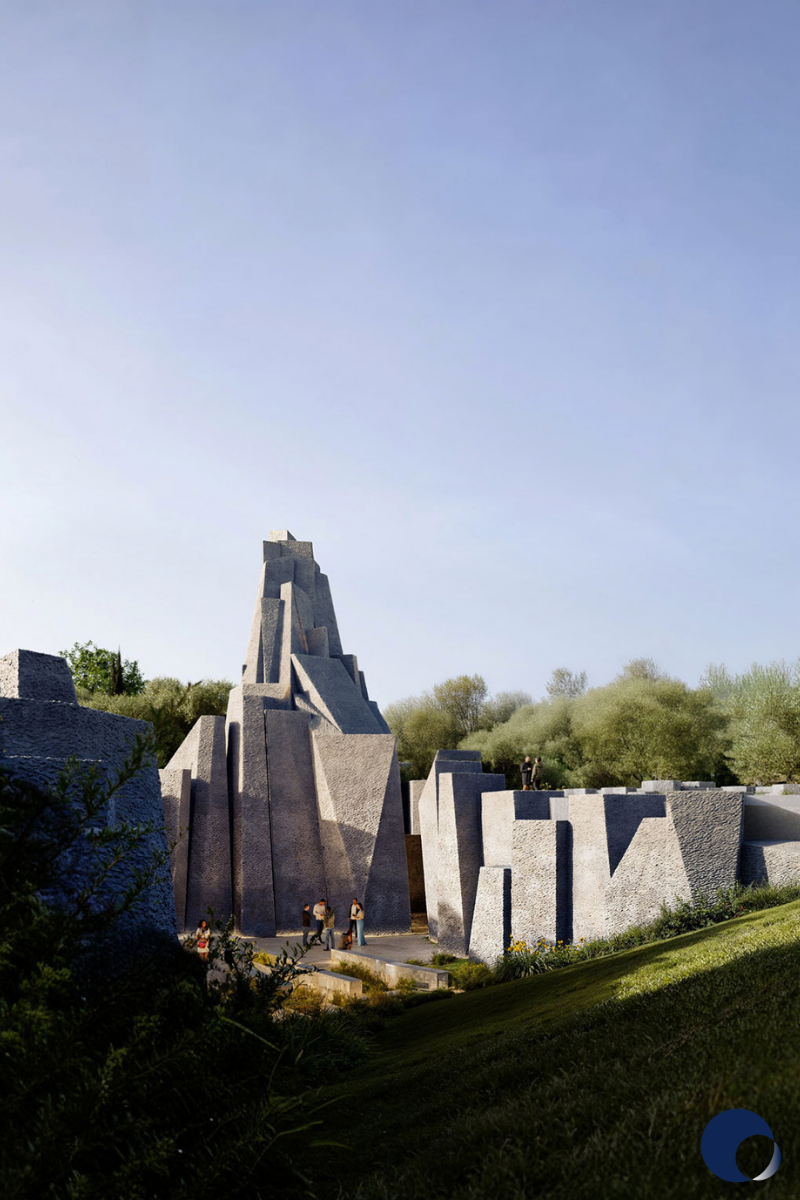
In a remote suburb of Istanbul, looking at the remnants of the rugged meadows gradually disappearing due to the endlessly expanding metropolis held together by highways and gated communities, reaching the Sancaklar Mosque atop a wind-eroded hill means capturing a moment of light. The only things you see are stone walls—one vertical, several horizontal, stacked loosely with stones as hard and raw as the ground itself. While wandering the site, you may suddenly encounter a cow. Nearby, another construction may be ongoing. Then, your foot might catch on a stone; you bend down and immediately spot another stone beneath it. Following these stones, you find yourself leaving behind a swollen mound under the weight of the hill and racing down it. Eventually, you arrive at a sheltered clearing against the wind. Here, the walls are concrete, and the roofs stretch out faintly to breathe.
Passing by these walls, you find yourself in an interior space where you wash your feet, hands, and face, before entering the mosque. Upon entry, the space unfolds. This is a cave carved into the hill. The floor slowly recedes beneath your feet, and you find yourself facing a concrete plane bathed in light from above. A recess in the wall indicates the direction of prayer (qibla). Next to it, steps descending to the floor invite interaction. The ceiling above gradually vanishes into the earth in layers. That’s it… you have found a place for spirituality. It is also a space for differentiation, withdrawal, contemplation, orientation, and congregation.
Few architects can combine order and ambiance as powerfully as Emre Arolat. Using a minimal palette—usually concrete, wood, glass, and stone—he works with geometries that express themselves through simplicity. On the one hand, he utilizes the full potential of the terrain; on the other, he respects the constraints that prevent fully expressive gestures. This does not mean that Arolat and his firm, EAA, lacked opportunities that other architects might envy. Nor can it be said that some of the firm’s projects are flashy or unoriginal compared to other corporate offices. Nevertheless, thanks to its position among the most successful offices in a country whose economy has grown significantly in the past decade, EAA has been able to undertake projects involving large commercial programs, luxury residences, and cultural buildings, taking advantage of conditions and sites that allow Arolat to employ the layers of Anatolia’s historical heritage in clean and elegant architectural compositions.
Arolat’s work neither consistently references local traditions and forms nor aims to create allure for global capital detached from place. Instead, he operates within standards and rules that ensure both financial and cultural success while striving to create structures that impart meaning to their locations.
It can be said that Arolat continues Turkey’s tradition of building. This includes the emphasis on proportion and sequence rooted in the grand Ottoman architecture, alongside a fascination with the potential of concrete frame construction—a hallmark of both modern Turkish construction and his mentors’ architectural practice. In a country that historically absorbed multiple cultures, recently turned toward Western styles, and long open to external influences, only recent generations of architects and artists have questioned the distinctiveness of their position within the global economy and culture. For architects, this is reflected in both the domestic construction boom and Turkey’s role as a provider of expertise in design and construction abroad, ranking second globally for a decade in export of such skills after China (as of 2017). Turkish construction firms often prefer collaborating with architects and other partners they have previously worked with internationally. Accordingly, Arolat, who has experience in this domain, is now extending his reach toward the United States. Furthermore, until 2018, general economic growth, combined with the ambitious vision of the Erdoğan regime, led to a boom, with Arolat designing large-scale private projects—mixed-use blocks, office towers, and shopping centers—as well as public buildings such as roads, airports, mosques, and social centers. While most of these constructions were in Istanbul, they also appeared in eastern Anatolia and major cities.
Few could have imagined that Bodrum, a small fishing village until a few decades ago, would become a hub of international yachts and holiday homes—some designed by Arolat—and a wealthy, indulgent, and economically polarized country. Despite the remarkable boom in construction, architecture has not always been able to keep pace qualitatively. Optimistically, the design quality of Turkey’s new large and small projects in recent years is generally neither better nor worse than global averages. When making use of available technologies—particularly reinforced concrete frame systems in Turkey—qualified architectural works emerge. Making the structural system visible and skillfully employed is a central tenet of Arolat’s architecture. Yet this approach is not merely a continuation of existing construction traditions. It is also an aesthetic choice and a continuation of the legacy of earlier Turkish architects such as Sedad Eldem and Turgut Cansever.
Arolat clearly admires these predecessors and follows their path. His frequently used three-dimensional grids, exposed concrete slabs, and the overall framework of elements with orchestrated spatial sequences honor this tradition. Closer inspection shows that the roots of this approach extend beyond construction techniques, material use, and post-Ottoman architectural practices. The proportions, rhythms, and near-perfection in buildings from the Ottoman era, particularly works by Mimar Sinan and contemporaries, are also present.
Arolat’s contribution lies in his interest in loosening structural order through shifting planes, cut and folded spaces. After establishing the grids with columns or blocks, he cuts them not with diagonals or curves but with hints, indirect references, and sequences. As you move through his structures, shifting and vanishing walls guide rather than dictate. In many residential and hotel projects, facades are animated with movable shutters or subtle movements in balconies, ledges, and ceiling details, which open up and enliven the building. This realization first struck me at St. Regis Istanbul, lying in bed, noticing an oval recess diagonally placed in the ceiling. Later, I saw similar spatial shifts reflected in the sharp-angled intersection of two streets elsewhere in the building. These elements can be traced across the three projects discussed in this book, all small in scale but diverse in function and context (commercial, religious, or mixed cultural).
Bodrum Yalıkavak Marina, the largest among the three, has undergone extensive modifications since its completion in 2014, affecting the clarity and purity of Arolat’s original design. The ‘horizontality’ principle mediating between ground and water, originally suitable for shops, restaurants, and bars, has been compromised by added pavilions, railings, and vertical elements on the second-floor level.
The project’s beauty lies in its restraint. It is composed of planes, columns, and sections that enclose smaller or larger structures, some surrounding shops or restaurants, others marking corners and turning points, and some enclosing service and hotel areas. In the landscape of steep mountains and smooth sea surfaces, these elements, clad in local stone, appear smooth and abstract. Walls primarily screen and define spaces, guiding circulation and marking paths, yet also contribute more. They indicate the next activity cluster and create a visual and spatial rhythm.
The same careful layering appears in other projects: at St. Regis, towers are broken horizontally; at Heyat Park Mixed-Use Complex, masses are fragmented; in Bodrum, villas are placed to preserve trees and avoid linear arrangements. Cultural venues are often hidden from view yet reveal themselves gradually through sequences of courtyards, terraces, and steps. This approach balances monumentality, openness, continuity, and spatial rhythm, creating clarity while integrating complex massing.
In the Sancaklar Mosque, an exception at the urban scale, the building stands entirely apart from its surroundings. Despite its modest size, the interior is striking. Here, Arolat constructs the project itself as a context, dissolving the structure into a series of paths, walls, and experiential elements. Natural stone stacked loosely replaces the smooth, finished forms of other projects, evoking ancient farm structures, huts, and menhirs. In adjacent residential walls, similar treatment integrates the building with the landscape. At lower levels, walls enclose the library, courtyard, and ablution area while becoming invisible upon entering the prayer hall. Light entering from ceiling slits and angled recesses still conveys the presence of the hill, the earth, and burial. Sancaklar Mosque transcends both its temporal setting and the daily routine, in ways that EAA’s commercial, residential, or Bodrum and Bergama projects cannot.
Although later religious projects reflect Arolat’s architectural essence, one should not assume he is a devout man. His success emerges when his work navigates the boundaries between meaning, mass, monumentality, abstract order, and daily chaos. Even when establishing order, he seeks to disrupt it, rejecting repetition and standardization. Units are designed individually, and large towers are fragmented or visually modulated, as at Zorlu Performing Arts Center. In Bodrum, luxury houses are placed side by side or stacked, preserving trees. At St. Regis, large cultural spaces are almost invisible, with foyers doubling as open-air viewing areas.
Ultimately, the archetype of an Arolat project may be the newly opened hotel in Antakya (ancient Antioch): suspended above archaeological ruins, linking various spaces via courtyards and walkways, creating a strong sense of place while evolving into something protected yet subtly revealed. Similarly, the Resim ve Heykel Museum repurposes an old warehouse, reflecting Arolat’s architectural position—poised between the historical and the contemporary, between what exists and the path ahead.
What makes Arolat and his team exceptional is their ability to reveal, in a coherent and consistent manner, spaces layered within urban or natural landscapes, combining tradition with commercial and construction norms, and transforming them into places where one can inhabit, observe, and experience the landscape, people, and divine presence.
Content: Tasarım Group
