



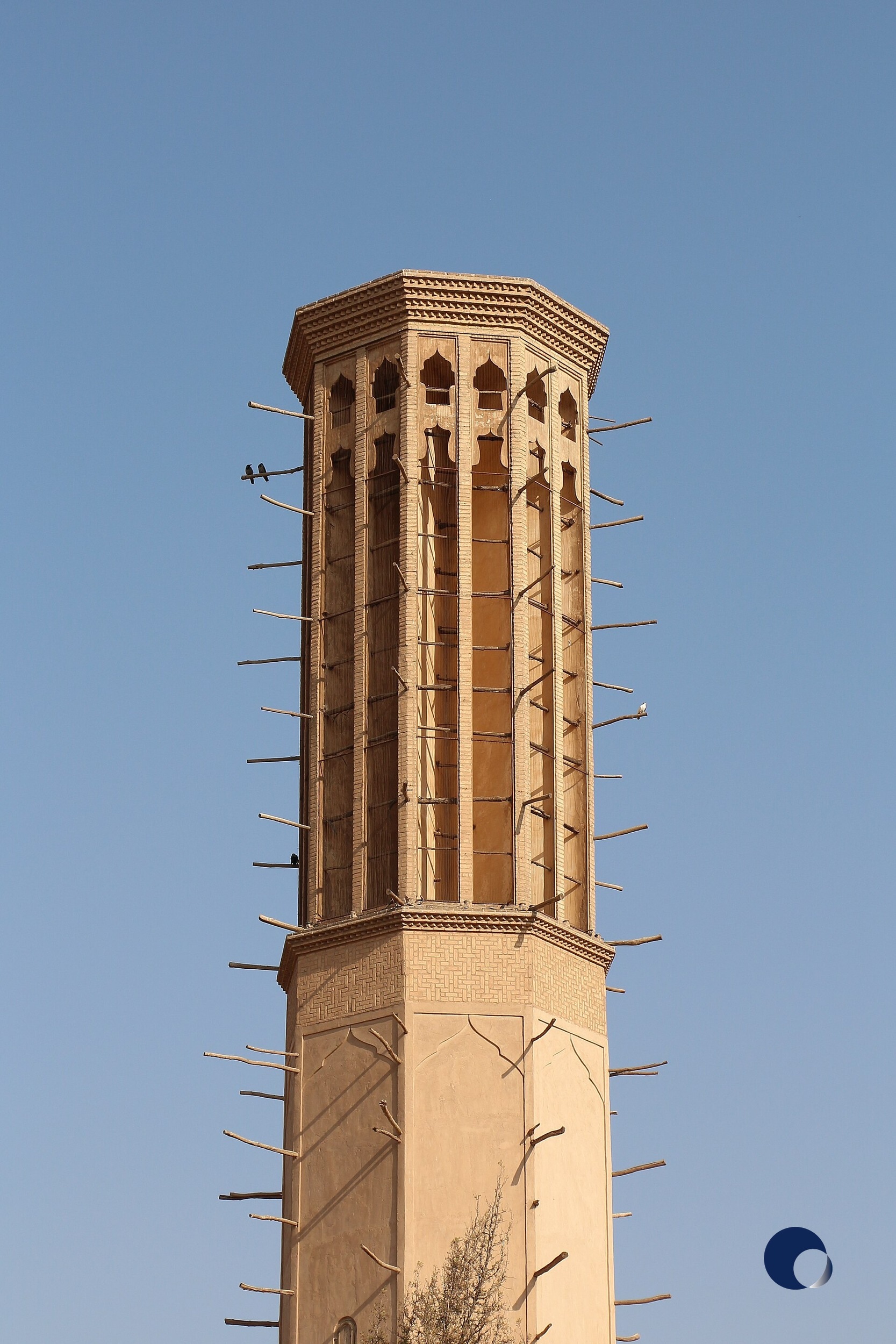
Lungs Sculpted from Sun-Dried Clay
In the heart of the Iranian plateau, between the vast sands of Dasht-e Kavir and Dasht-e Lut, lies the UNESCO-listed city of Yazd. Facing one of the most punishing arid climates on Earth—where summer temperatures routinely soar past 50°C—ancient Persian engineers perfected the 'Bâdgir' (windcatcher), the undisputed ancestor of zero-carbon bioclimatic engineering.
Looming gracefully above adobe rooftops, these monumental towers harness prevailing thermal winds from high elevations. Without consuming a single watt of electricity or relying on mechanical fans, the Bâdgir transforms aerodynamic principles into an immortal cooling machine.

“The Bâdgir is pure spatial intellect—capturing invisible currents of air and marrying the breeze with subterranean waters to craft oasis comfort in the desert furnace.”
Aerodynamic Pressure and the Bernoulli Principle
Internally, a Bâdgir is divided into multiple vertical shafts by clay partitions termed 'parre.' When high-velocity ambient breezes strike the windward louvers, high positive pressure forces air downward into the domestic living spaces, striking a central marble fountain basin ('havuzhane').
Astonishingly, when the wind subsides, the tower shifts seamlessly into an exhaust mechanism via the stack effect: solar radiation heating the leeward shaft causes warm air to rise, generating negative pressure that pulls subterranean air upward through the house. The fluid mechanics described by Daniel Bernoulli in the 18th century were systematically weaponized in Yazd a thousand years prior.

Symbiosis with Subterranean Qanats
The full technological genius of the Bâdgir manifests in its integration with 'Qanats'—centuries-old subterranean aqueducts transporting snowmelt from distant mountain ranges. Downward-diverted desert drafts travel over the subterranean waterways, inducing instantaneous evaporative cooling.
As the dry air absorbs microscopic water vapor, its temperature drops precipitously by 10°C to 15°C, while its humidity rises to optimal comfort levels. This heavy, chilled air settles effortlessly into sunken summer rooms ('sardab'), creating a sheltered microclimate of profound tranquility.
A Bioclimatic Compass for Modern Cities
With global air conditioning currently consuming approximately 20% of global electricity, the Bâdgir of Yazd stands as a timeless beacon for future architecture. Visionary modernists like Norman Foster have revived these ancient aerodynamic geometries in projects like Masdar City, proving that the pinnacle of thermal efficiency is already written in desert clay.
Content: Moon Content Team
